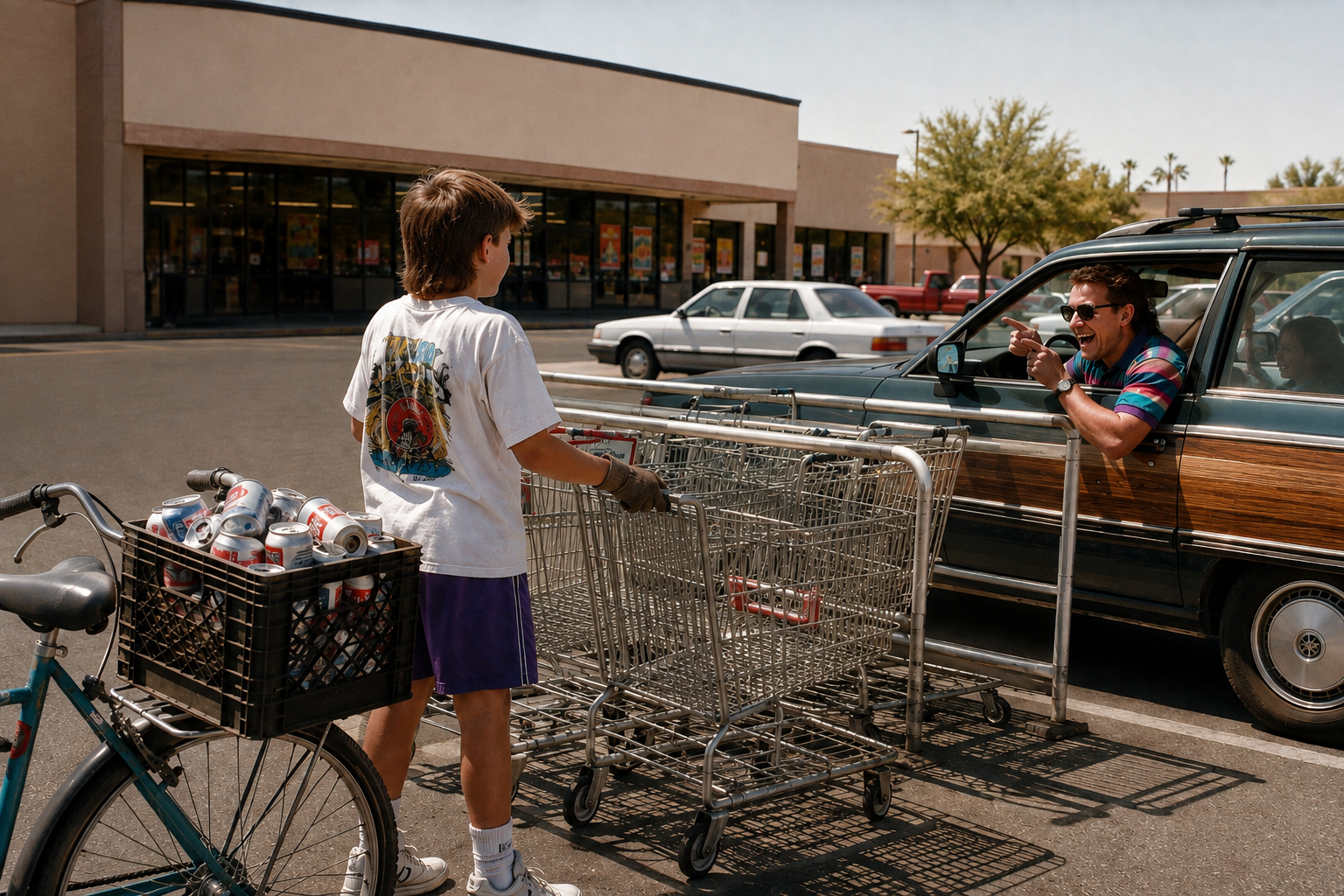
In 1992, at twelve years old, I would ride my bike around my west Phoenix neighborhood, collecting aluminum cans to recycle for some spending cash. After one particular drop-off, I had the bright idea that if I went across the street to the grocery store and spent a couple hours bringing in shopping carts, they might want to pay me or give me a thank you gift from the store. I didn’t get but ten minutes into my cart wrangling when a family childhood friend showed up and laughed at me. I got on my bike and went home.
My parents have been referenced as workaholics. Living with my mom and stepfather, my sisters and I were latchkey kids. In February 1993, I got the opportunity to interview the head coach of the Phoenix Suns, Paul Westphal, meeting NBA star Charles Barkley afterwards. My father and stepmother each worked overtime jobs as well, although I didn’t live with them until the summer of 1993. My first job didn’t come until 1995, where I was allowed to work with my stepbrother and stepmother at a furniture refurbishing warehouse. I got a school year job at a local movie theater in 1997, followed by a grocery store and Taco Bell stretch.
During my senior year, I produced the high school morning show with a Friday variety show where I would film places like Planet Hollywood and Hard Rock Café. The latter opened me up to an interview with blues guitarist Jonny Lang. After graduation in 1998, I spent my last summer at the furniture warehouse before going to Ball State University in Muncie, Indiana in the fall. I had one, short-lived job at Ball State before moving back to Arizona at the end of the semester.
Back to Taco Bell to start off 1999. I moved back in with my dad for three months before moving in with my sister across town. My Taco Bell manager transferred me to a local store which I worked at until getting hired at the Metrocenter Mall Best Buy. Nine months later in December, I was looking to move in with a couple high school friends, when I was let go from Best Buy.
I moved in with my friends and began a new job search. A TGI Friday’s in walking distance from our apartment was opening and while I had no experience, they didn’t have enough applicants, so they gave me a shot. Thirteen stores in six states over the course of nine years, it worked until it didn’t. I worked a night audit job in 2000 at a local hotel for a few months until the schedule became too much. I was subsequently rehired by Best Buy in 2002 as my firing in 1999 was deemed by the manager as a miscommunication.
Advancement at either of these places became unattainable. The TGI Friday’s franchise Main Street Restaurant Group was acquired by Briad Main Street, LLC in 2006, the start of the end. Movies like Waiting and Office Space did not help the downfall that resulted in abrupt closings in April 2013. Best Buy bounced me between departments and roles, some in leadership, before I was ultimately unable to advance.
I attempted to change careers a couple times. I had married a coworker from Best Buy and received my first mortgage in 2005 going into the 2007 housing collapse. I worked long hours at the Shamrock Food distribution warehouse in Phoenix before attempting to work in life insurance for American Income Life Insurance (AIL). From hourly pay to incentive pay to full commission pay seemed like a good way to go to prevent advancement ceilings. Neither was good for my home life, and we separated while the courts took over.
A newborn son in 2008 followed by a divorce destroyed me. I moved into a small townhouse as the house went into default. My bills got higher, and I could not keep up. I worked three jobs, seven days a week. Sunday and Monday nights I bartended at a local pub. I was a food server at Saddle Ranch Chop House Tuesday through Saturday evenings and a Best Buy merchandiser in the mornings as scheduled. I fell behind on child support with no visitation rights beyond supervision with supervisors that weren’t available with my schedule.
I was ready to commit suicide. But I knew I could not and would not.
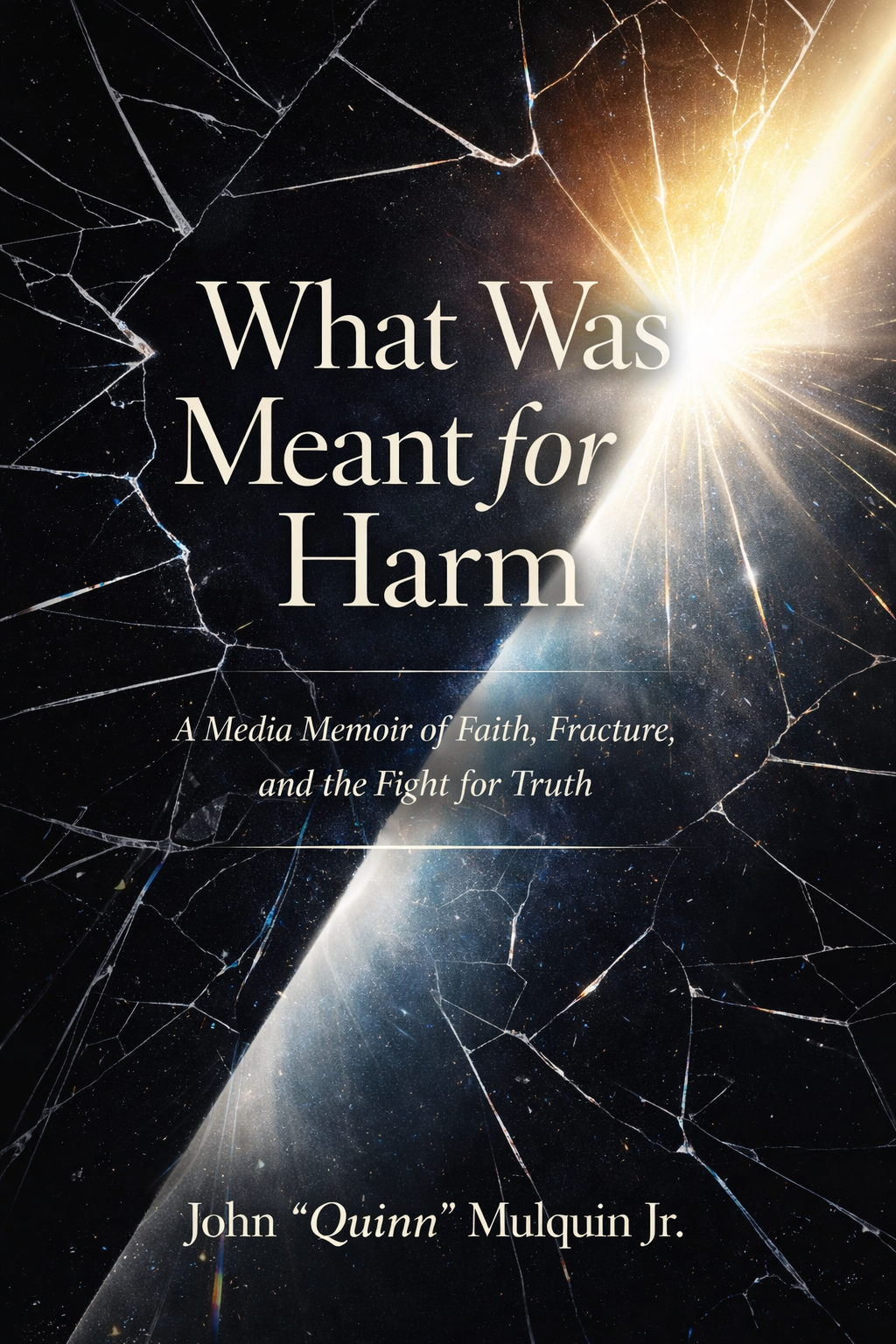
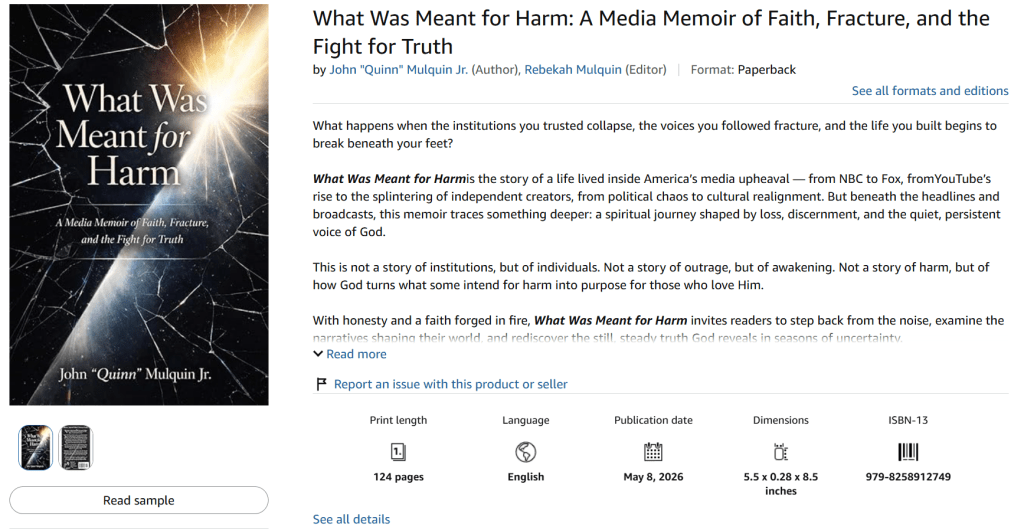
If I died in the military, I thought, then at least my son could get the payout. As mentioned in my media memoir What Was Meant for Harm, I prayed outside of the MEPS station in Phoenix before signing the contract.
If I was going to work 24/7, I might as well join the Army at 29 years old. If I die, my son has money. If I live, let God use the rest of my life for His purposes.
I was stationed in 2009 at Fort Bliss in El Paso, Texas and immediately deployed to the middle east. After returning from deployment to Iraq in 2010, I met my wife, married in February 2011, with our son being born later in October.
My military service from 2009–2012 ended four months early with a downsizing involuntary separation prior to my contract expiration date.
I set myself up to use the Post 9/11 GI Bill at the University of New Mexico beginning in 2013, moving into student family housing the week of Christmas 2012. I returned to a Best Buy in Albuquerque, New Mexico. I was laterally promoted from Merchandiser to Project Team Member, with twice the responsibilities and stagnant pay at $10.50/hour. Best Buy worked with my school schedule, but as summer 2013 rolled in, I saw I could make more working with my stepbrother, who had begun his own office furniture installation business in Albuquerque, so I called my Best Buy supervisor and quit once and for all.
The Veteran’s Affairs Administration diagnosed me with PTSD, right hip bursitis, and sleep apnea, leading to disability compensation beyond the GI Bill benefits. By fall 2013, I was prepped to focus on school. It was time to build something of my own.
At 33 years old, I didn’t necessarily go to school for the education, but I was interested and learned a lot in the Film & Digital Media courses I took. I thought I might meet the right people, create an entity with fellow students, or find work in the local film industry.
By the end of 2013, I had gained somewhere around fifty pounds from the beer drinking I had engaged with since leaving the military. I looked into the New Mexico Medical Cannabis program and made the switch to get off of the Prozac and Zoloft from the VA. In about three months, I had lost the fifty pounds and reduced beer drinking by a large percent. I was no longer in a pharmaceutical haze. I began having hope again for the future. The end of 2013 had us moving into a rental home from student family housing. Quite the step up I might add.
Three classmates and I began looking into making a movie. I began looking at the legal LLC structure for movies and began drafting potential contracts. One of the members did not like the forward-looking nature of the entity I had drafted, and I was pushed out of the group. They wanted a hobby, not a business.
Taking what I had learned from my first year and a half in school, I registered my new business entity, Next Step Media Productions, LLC (NSMP), in April 2014. A City of Albuquerque grant of $5000 and a loan helped me get the equipment to get started. By fall, I had been hired by Green World Health Net to be their Warehouse, Volunteer, Donation, and Social Media Manager, paid through a work-study program for the school year.
At this point I had always had a job. If I wasn’t working the nonprofit, I was working on building Next Step Media as an upstart. If I wasn’t doing that, I was taking care of my schoolwork or bouncing between appointments at the VA. My wife could see that I, too, had become a workaholic. We had a conversation acknowledging that I needed to ‘play’ more. I needed to work every day to earn that play, or so I thought.
Summer 2015 came, work-study ended, and I was back installing furniture, still going to VA appointments and seeing what I could do to build my own business. August was my first attempted paid project that resulted in a failed product and refund to the client. Disappointed, I began to redefine my services. In the same month, I applied for a mortgage-free home through the Military Warriors Support Foundation (MWSF).
I took a Boots to Business course through the University of Syracuse at Kirtland Air Force Base in the fall 2015 while also applying for Veteran’s Vocational Rehabilitation and Employment (VR&E) benefits. I refined my business plan, met other veterans seeking self-employment or business start-ups, set myself up for an internship with the New Mexico Film office and an independent work-study through GI Bill courses at UNM for the spring 2016.
It turned out that my MWSF mortgage-free home application had been lost in the shuffle and was found in December, right before the Gildan New Mexico Bowl, where we were given a symbolic foam key gifting our family with a house outside Belen, New Mexico. The deed was not transferred until we had completed a three-year financial readiness program. A story for another time.
I was soon let go from my spring semester NM Film office internship for asking too many questions, let’s say. I shifted the internship into creating a promotional video for my stepbrother’s furniture installation company, also helping them with their website. I continued building NSMP through the independent work-study, reaching out to the Belen Chamber of Commerce with an introduction. My application for VR&E Self-Employment benefits was denied and I appealed the decision.
I found a mentor in Belen that contracted me to create promotional videos for the Belen Mainstreet Partnership, New Mexico True campaign on the Rail Runner commuter trains from Belen to Sante Fe, and a contract with Concerned Veterans for America (CVA) leading into the 2016 elections. The season became a proving ground of what I was capable of producing while I continued courses at UNM. I found a handful of other individuals to contract me to film their events, video applications and performances. Work I am still proud of, even if the quality wasn’t what I would later produce. Some of those videos are still available on my YouTube channel.
The CVA contract ended shortly after Donald J. Trump was elected President of the United States in November 2016.
I reached out to staffing agencies and joined a background acting agency. I got to be on the sets of Night Shift (Season 4, Episode 1), Midnight Texas, Get Shorty, The Girlfriend Experience, and an unaired CBS drama pilot, Mission Control. While I enjoyed the experience, I found the hours and pay to be unfulfilling. Waiting around to be called to set gave me time to consider what I had rather be doing. I removed myself from the roster.
I graduated in May 2017 and returned to office furniture installation work with my stepbrother. I was hired by one of his employees to film their wedding in September, giving me the opportunity to work in my field, even if only for the price of a hotel room for the night. I had always looked up to my stepbrother, encouraged by his strong individualism, family, faith, and independent work ethic, although I began to realize that I was seen as the messed up little brother and not an equally valued member of the business—or family.
It made sense as I was a seasonal employee, at best, and my stepbrother had no interest in looking at my media skillset for business integration into his. It seemed this season was Godsent, as the attachment I had to my older stepbrother had become unhealthy for me in finding my own way and God-given purposes. I attempted to confront and reconcile the differences I had with my stepbrother, only to find out that I was the problem. I was somewhere I did not fit in or belong. Message received.
Chapter 3 of my media memoir, What Was Meant for Harm, speeds through 2017 and 2018, as the Independent Shift. The talented Ms. Van Ann Moore hired me to film a couple of her performances, my 20-year reunion asked me to put together a reel from our high school days, and my mentor from the chamber had one more video for me to make that would become my most watched video to date for the Sugar Bowl Bowling Alley in Belen, NM. I’d like to say the video was great, but the reality is that it became the last testament to the building itself, as it burned down two years later in the summer of 2020.
I ended up making more money at a casino in 2018 than I did trying to find work in between VA appointments. They gave veterans free chips every week, so I would show up, play the freebies, and leave. Sometimes with zero, sometimes with $40. After a $5000 win of tic-tac-toe, I stopped going to the casino altogether having perceived myself as winning more than I was losing.
I started making YouTube videos myself and created Quinn’s Next Step as a way of sharing insights and ideas for public debate and discussion, from individual responsibility to collaborative subjugation, from the Word of God to reading the first chapter of Ecclesiastes over a slide show.
2019 became a reset. No YouTube videos. No contracts. My wife and I were unable to find the medical care we needed, and safety concerns were increasing in our small New Mexico town. God’s timing, despite the tough year, couldn’t have been better. We moved to the Texas Hill Country by October, after a two-week summer trip around the Canyon Lake area between Austin and San Antonio.
We were homeschooling our son and I was sending out introduction emails to find work nearby. The COVID-19 pandemic emerged nationwide in March 2020, and we were safe and ready. I picked up a merchandising job that lasted a few months before I quit. My supervisor let me know when I resigned that he thought I was overqualified for the position, but appreciated the work I had done. In August, the Studios at Fischer picked me up as an A/V technician for livestream concerts they were producing while touring had stopped due to lockdowns.
I expanded my contractor base in 2021, picking up camera operator, video switching, PowerPoint, and video playback operator gigs in Austin and San Antonio, as Governor Greg Abbott opened Texas back up for business. Hotels, conference centers, corporate meetings, concerts, and brand activations gave me somewhere to show up and deliver. At home, I helped my son create his own gaming YouTube channel going into 2022. His natural on-air talent was inspiring.
Contractors kept me busy, increasing my coverage and experience during peak live event seasons, although I felt another tug to redirect myself, again. What was I to do when there were no gigs to work? What happened when I had a higher paying contract come in when I already committed to a low day, low pay contract? I respectfully cancelled the lower contract, offering recommendations for replacement, without burning the contractor. Everyone was looking out for themselves, myself included, and that became okay.
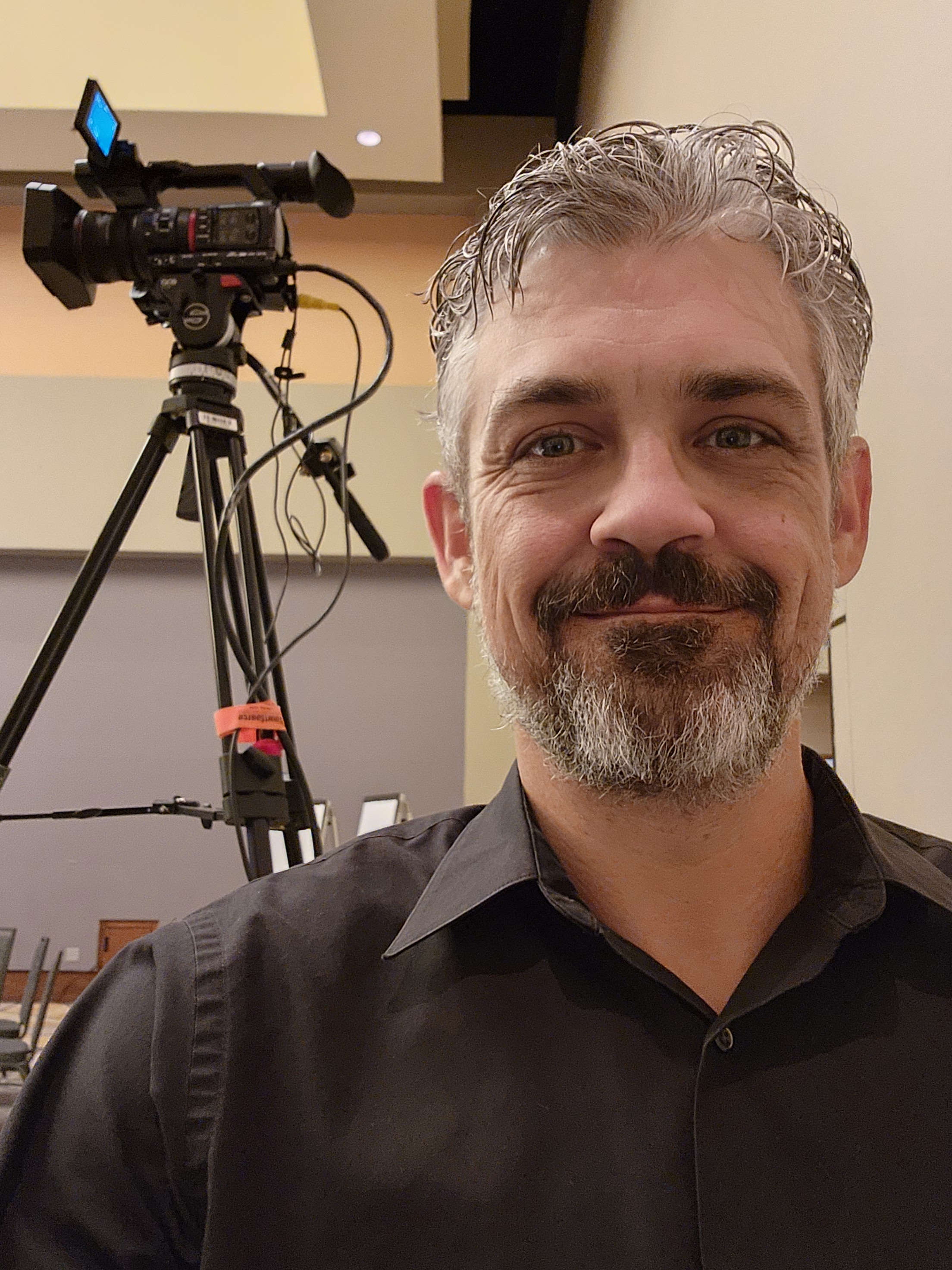
I felt a pull in 2023 to re-engage with Quinn’s Next Step more intentionally. Could I figure out how to create content myself? Website, YouTube, Rumble, Locals, Twitter (now X), Facebook, and LinkedIn became my distribution.
Food videos, DIY videos, video games, and news became the genres I wanted to create. A motion-activated game camera picked up wildlife migrating through my property that I could share with others. Not a niche channel, I had created a variety show from scratch, recording what I wanted, when I wanted. A series of shorts attempting to remove a field mouse from my backyard became a fan favorite. A cameo on a short-lived podcast called People of the Internet encouraged me to keep going.
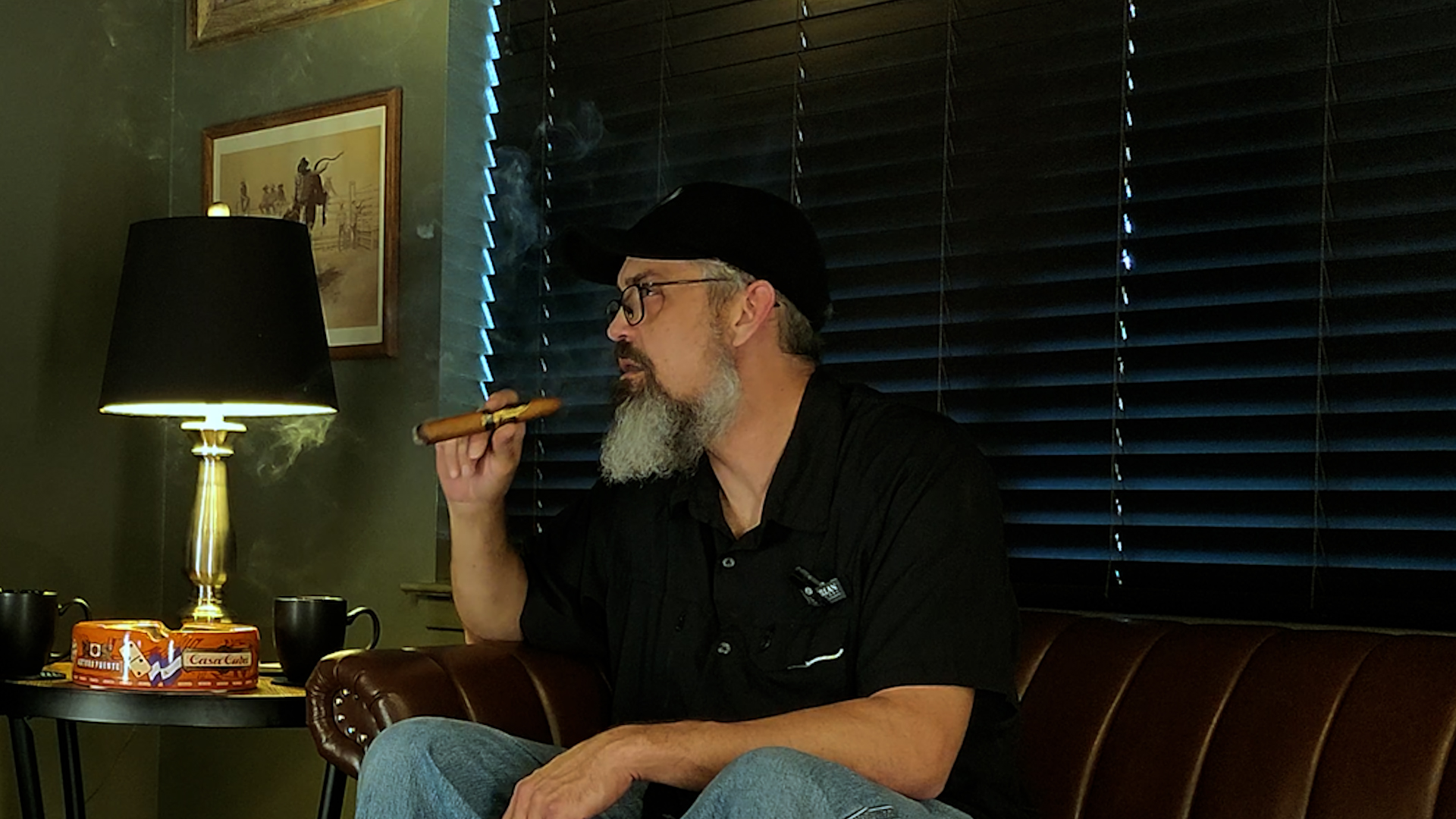
I ended the year going into spring 2024 creating a series of videos reviewing the pros and cons of different job and career avenues I took since my first job at Taco Bell. Similarly to this post, I was looking at where I came from, why I quit jobs before they could quit me, leading me to independent contracting. When I wasn’t on contract, I was creating videos for my YouTube channel. I was led to work with people, not for people. I just hadn’t found the people locally to work with. I looked up cigar lounges in the Hill Country to produce a new series. Free advertising for them as I was building the proof of concept, with over 3,800 views between the four lounges to finish up the spring season.
In Belen, New Mexico, I had introduced myself to the local chamber of commerce that had opened me up to multiple contracts, so I decided to attempt the same thing with the Wimberley Chamber of Commerce during the summer months. Introductions, presentations, proposals and quotes resulted without fruit. I ended the relationship with the chamber, taking a couple friendships with me, having spent through startup funds participating in chamber activities.
I entered a dry spell in contractor gigs in 2025 with the closing of the Austin Conference Center, a change in the labor coordinator with one of the contractors, and less available work at the Studios at Fischer. I attempted to go back to regular employment, sending resumes out to a dozen or so different companies from San Antonio to Austin. I could make it through multiple interviews, video submissions, and final in-person interviews before ultimately not being chosen for the role.
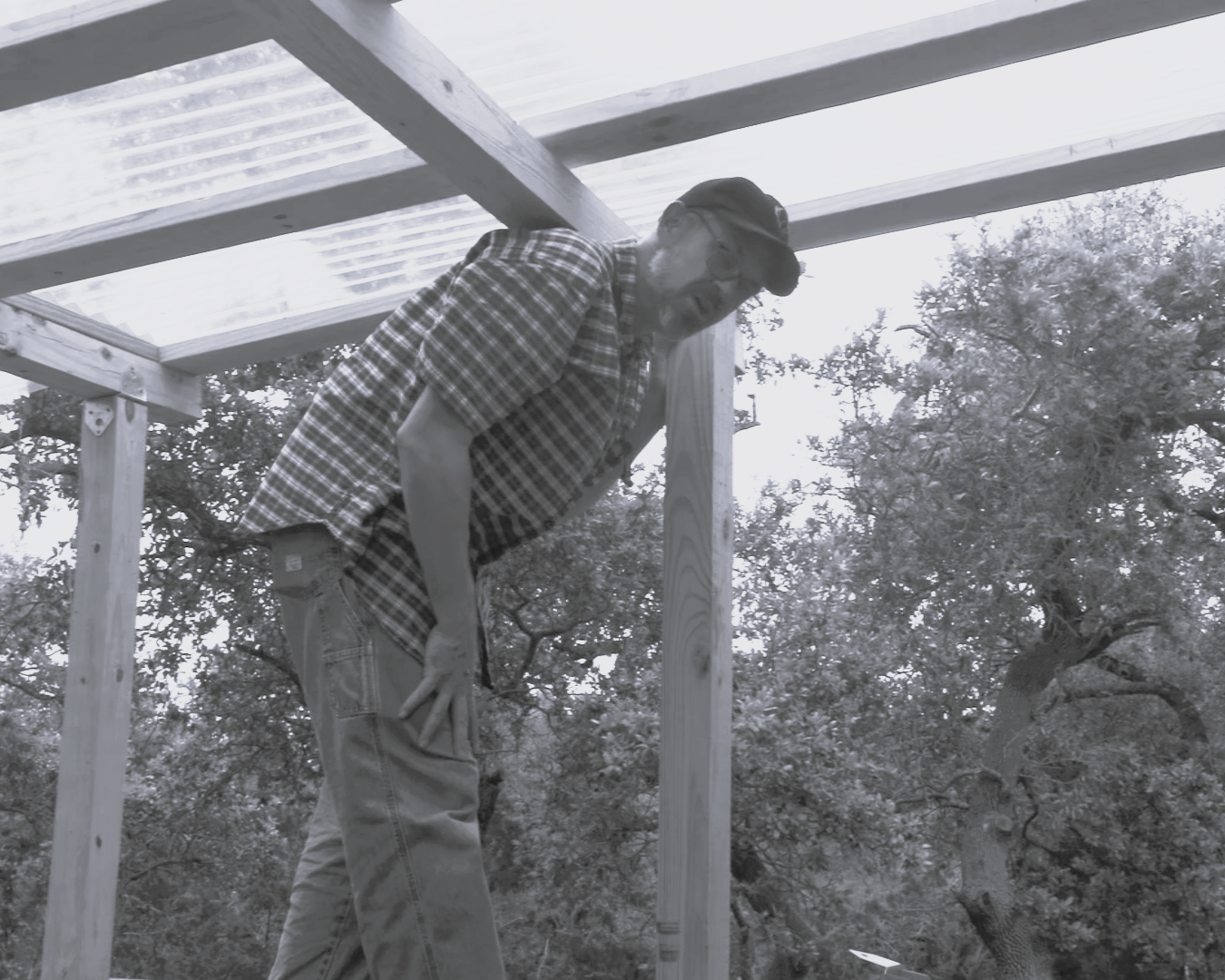
My video output on YouTube had decreased as I attempted to bridge gigs, resume submissions, and in-person outreach. I began to build a roof for my patio. I reached out to a local construction company to see if they wanted to fix my mistakes on camera with an in-kind way of free video and social media advertising for them. It turned out that they were too busy to participate.
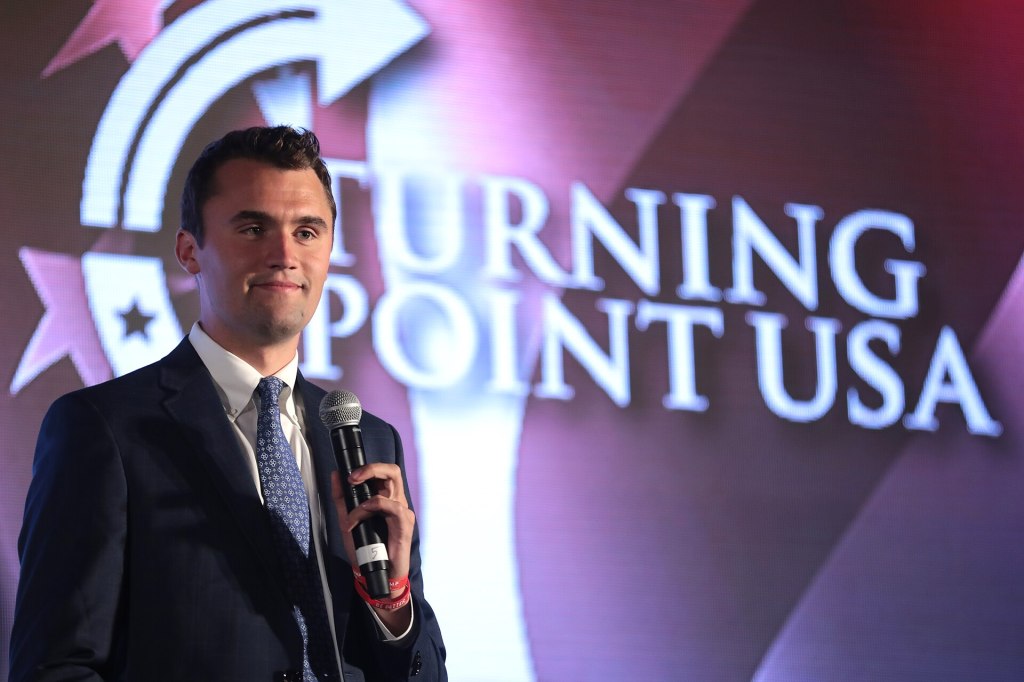
In an unexpected twist, I tore down what I had built on the patio and began editing the footage the day TPUSA’s CEO, Charlie Kirk, was assassinated on September 10, 2025. The parallel of two unrelated things being destroyed at the same time caught my attention, renewing my faith in the process. A carpenter two thousand years ago was murdered for speaking truth to governmental and religious powers of his day. Is that what I had just witnessed? Was Charlie Kirk the latest Christian martyr in a history full of them?
As my faith was being renewed, my identity in work and conversation became less of a concern. I ended therapy at the VA. I stopped meeting up with a chamber friend. I stopped volunteering with the church youth group. My son had developed gastrointestinal issues that affected him for a month. I applied for a substitute teacher role I would later have to decline as the state’s Medicaid was dropping my wife and son.
I took my family on a two-week vacation to Florida to see old friends, family we hadn’t seen in over a decade, and a successful three nights at Legoland. Upon returning the second week of November, we confirmed our son’s health improvements with labs, CT, primary-care doctor, and gastroenterologist. The following week would reveal that our German Shepherd of ten years had a splenic mass rupture. She passed away on December 6, and a deep mourning ensued. I finished the year with a couple brand activations at an outdoor mall, a welcome distraction in my grief.
2026 would bring an end to sporadic contracting in Austin or San Antonio for my two remaining contractors. The Studios at Fischer were looking to sell.
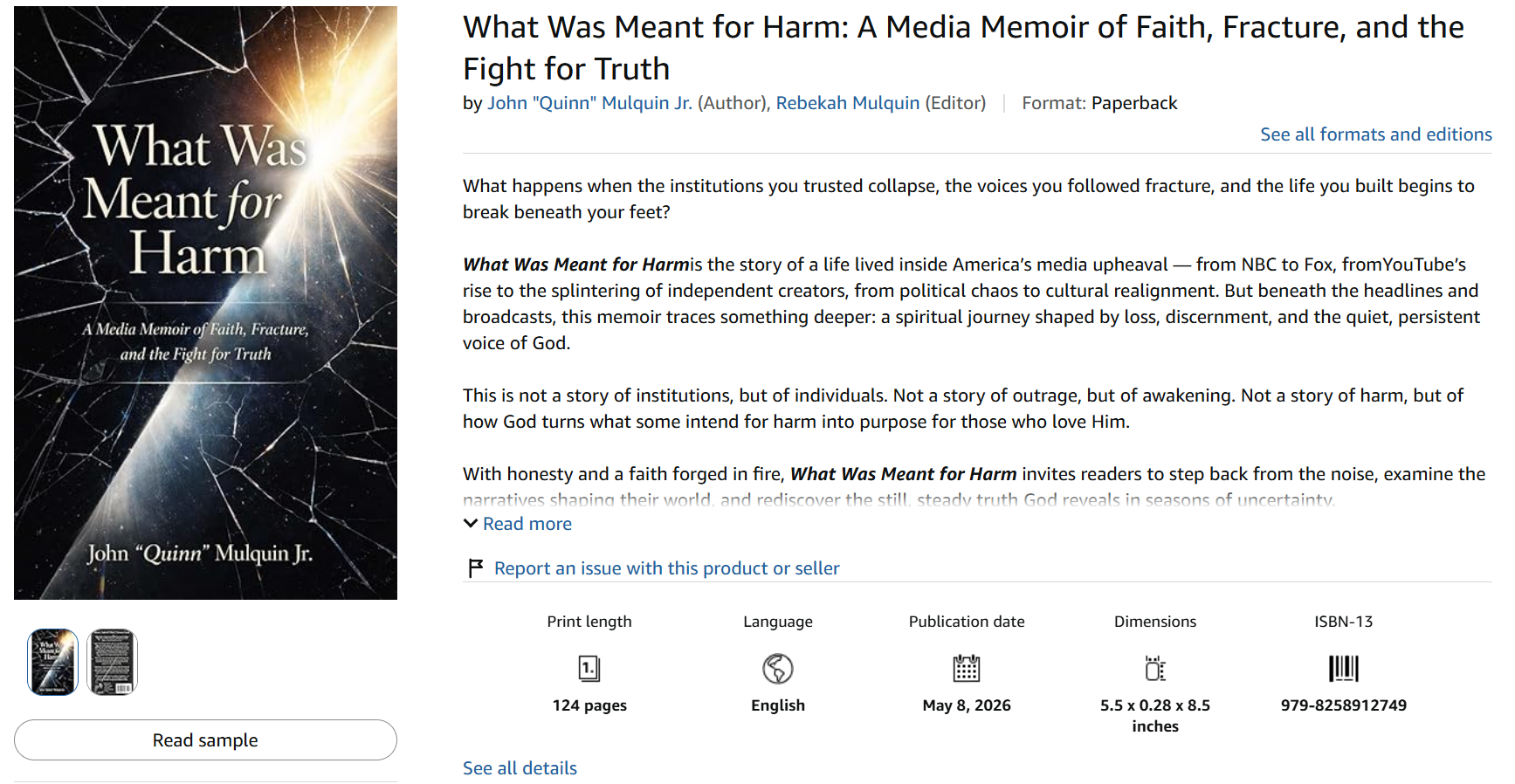
Before I knew it, God had led my wife and I to publish my media memoir What Was Meant for Harm on May 8. I thought I was writing about the media landscape since I exited the military. It soon became a personal story of loss, faith, and fracture, and how God uses moments and seasons to reveal something greater. With no marketing or advertising budget, my wife made video shorts leading up to its release for social media channels.
I wrote a week of blogs promoting the book and giving further insight. I then turned my focus to write about why I feel the way I do about churches with a couple childhood memories. I continued to follow the Charlie Kirk story, when June brought two more stories to the forefront: a case involving allegedly stolen LEGO by the corporate Bricks and Minifigs reseller, and the cancellation of a new Stargate series. I saw authorities and institutions corrupting the values they said they stood for, and breaking the trust of the public, at every scale.
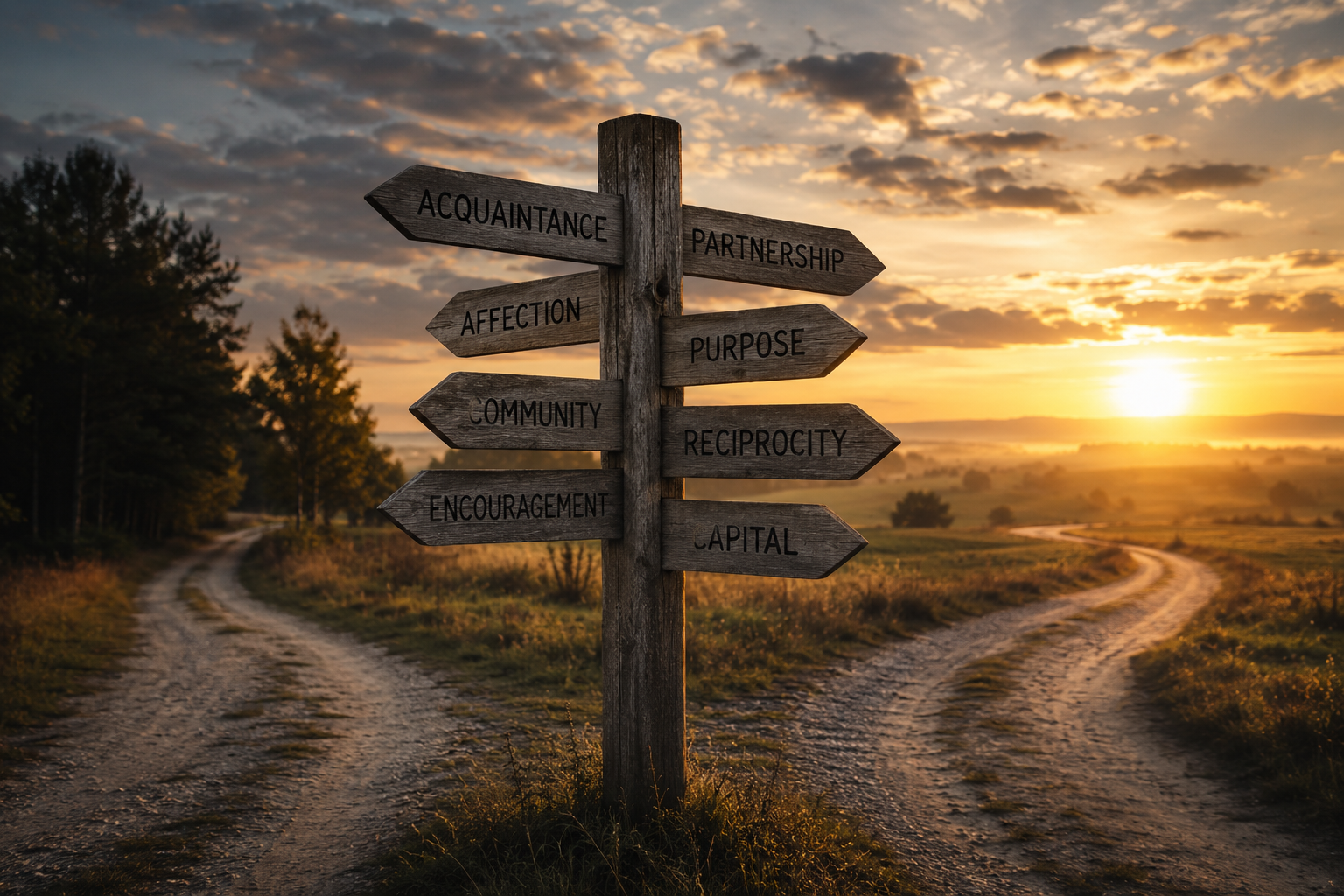
Institutional work looks bleak, and yet I have returned to LinkedIn and Indeed to open myself up to the possibility there is a purpose and position right for me within an institutional community. Working overtime for an organization or volunteering takes time and energy I could use toward my homestead, wife, and son. I took the time off last month to finally rebuild my porch roof. My last blog was The Reciprocity Gap, where I battled with the transactional nature of friendships, employment, contracts, and community.
Now I am right back where I have always been. A couple of open proposals sit pending response, approval, continuation, or cancellation. Rejected resumes came back quickly; only two remain pending. God made me to write, so I will continue writing. I remain open to the possibilities and purposes He may still have for me in community. While I am skeptical of institutions, I was made for interactions with other individuals.
And here I am. No steady job. No active contracts. No formal community role. No work stability. No income beyond disability.
And yet, with God, I have no worries.

 Quinn's Next Step